1 When will the technology be brought to market?
We aim to have beta testing units by autumn 2026. Following some manufacturing and technology optimisation the technology could be launched in 2027.
2 How much do the units cost to buy and to run?
Pricing is in development: For a unit to process slurry from a herd of 450 milkers we expect the cost will be <£500K and running costs <£10K per year.
3 Apart from Harper Adams, do you have the technology working at other sites?
Currently no. We’ve put together a proposal to place the technology at 3 additional locations. If this is successful, the process could be running at additional sites towards the end of 2026.
4 Will the units be available to try before buying?
No. However, we will try to ensure that demonstrator sites can be visited. Pre-purchase we could also offer to run test samples through the system. From samples treated at a smaller scale we are able to extrapolate what full-scale output will be.
5 Are you in communication with Defra in regard to getting farmers grants on this in the future?
We are not currently speaking directly to Defra but have requested that Innovate Business Connect advise how to have this technology put onto the list of approved equipment for future use on the Farmers Grant.
6 Will permitted development planning be necessary for these types of units?
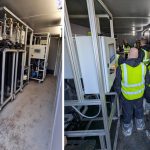
Taking to shreds and liquid requires a separator which most farms already have in place. The additional equipment required to process slurry from a 450-strong herd of milkers fits into two standard 20-foot storage containers. If hard standing for such a container is already in place our understanding is that no planning permission is required. Conversely, if the equipment is to be housed in a new building, planning permission may be required.
7 Will a permit from the Environment Agency be required?
Our current understanding is that an environmental permit will be necessary to run any post shred treatment of slurry. We are currently in contact with the Environment Agency to try and get a solution set in place that will make it easy for farms to adopt our technology.
8 How much user time will be required daily to operate the system?
The process is automated and runs continuously. It should be checked at least once a day. This can be done remotely.
9 Would farmers need an additional store for the different nutrient fractions and what size would this need to be?
The short answer is yes, you need additional storage, but you’re not storing more volume.
It’s just you need to store it separately. The precise storage needs will very much depend on the scale of the operation and the circumstances of any given farm. Many farms will sell the solid P-rich fraction and just store N-rich for farm use in an existing store.
We assume that the water fraction will either be directly discharged or stored in an irrigation lagoon. You may or may not have a need to store the water.
10 Under the NVZ regulations, slurry separators don’t count in England towards the five-month capacity figure, but they do count in Wales. Will you be looking at this with the environment agency. If a consistent reduction in volume can be achieved could this process count towards storage figures?
This is an important point. We have not yet addressed this but will certainly be making the argument that a reduction in storage requirements should go hand in hand with consistent dewatering of slurry.
11 Are nutrients in the recovered fractions bioavailable?
In a previous project in a four cut grass experiment our recovered phosphorus fraction outperformed even the artificial fertiliser treatment, both in total dry matter that was generated and metabolisable energy.
As part of the current project, crop trials on both grass and wheat are in progress. We will also be comparing nutrient leaching and greenhouse gas emissions of the recovered fertilisers with current slurry management practices and artificial fertilisers.
12 Can the fractions be remixed for specific Phosphorus (P) & Nitrogen (N) levels for specific application?
Yes, fractions can be remixed. We are removing 95-98% of the P from slurry into the sludge-like phosphorus fraction, however, approximately 50% the particulate nitrogen is also present. The nitrogen fraction is a quasi-nitrogen only liquid. Nothing prevents remixing of these fractions to meet specific crop and soil needs.
13 What dry matter content can be expected from the sludge and liquid portions?
The reason for asking relates to storage required for the sludge and considerations for type of suitable spreading equipment.
Slurry volume reduction is achieved by taking water out of the system either to safely discharge or reuse. Currently a volume reduction of 30 to 50% can be achieved.
Typically, the input at Harper contains anywhere from 4 to 6% dry matter. At the present time we are taking the phosphorus-rich fraction to 7-8% dry matter. We want to drive that harder but still retain it as a spreadable liquid. Alongside that, particularly for those interested in off farm export, we’re looking at what modular techniques or technologies we can add on to make that phosphorus fraction into a cake at around 20-30% dry matter, so that the phosphorus fraction could be cost effectively transported off farm.
The process captures soluble phosphorus as a particulate that is then filtered out of solution. Thus, particulate nitrogen is also filtered out and so a certain percentage of nitrogen is present in the phosphorus-rich fraction. The amount of nitrogen present will vary depending on the input but in our experience about 50% of the nitrogen present in the liquid slurry is found in the P-rich fraction.
The nitrogen fraction is a virtually solids-free liquid and contains almost no phosphorus, unless the farmer would like some phosphorus content in which the technology can be operated to deliver this.
The process can be controlled to deliver consistent amounts of phosphorus and nitrogen in each fraction. Specific amounts will depend on the input and there is no reason why the fractions cannot be mixed to meet the needs of a specific site.
Note: Our data is based on Harper’s slurry and we know that slurry characteristics vary.
14 We’ve got a couple of questions about ammonia and emissions.
We’ve been tracking ammonium throughout the process. In addition, we would like to quantify gaseous emissions during storage of the concentrated nutrient fractions.
15 Can nutrients in poultry manure be fractionated?
We are interested in doing this but have not yet run poultry litter through the system. It’s a somewhat different beast because the phosphorus and solid content are both very high. We are optimistic that the process can be developed to fractionate nutrients from poultry manure, but we don’t yet have process data to report.
We will seek grant support or private funding to develop this application once we get a little bit further along with the dairy application.
16 Have you considered the energy value of the sludge created for export off farm and use at anaerobic digestion facilities?
We’ve not looked specifically at the energy value in fractions that could potentially go off farm. Our goal is to produce as concentrated a phosphorus fraction as possible. If it’s exported off farm to be applied directly to soil or to feed an anaerobic digestion plant that’s entirely up to the end user.
17 Have you considered the use of these units at anaerobic digestion (AD) plants for digestate nutrient management?
We think our technology could be a useful add-on to AD plants. Currently, our process performance in terms of phosphorus removal from digestate is variable. We think this is likely linked to the AD feedstock.